
Draft Guidance on Container Closure Systems for Packaging Human Drugs and Biologics Released
The FDA recently released a revised draft industry guidance entitled “Container Closure Systems for Packaging Human Drugs and Biologics.” The new guidance comprehensively updates the industry guidance for container closure systems and directly replaces the previous guidance, which had been in use for more than 20 years. The new guidance establishes that packaging is not merely a “container,” but also a “functional component”.
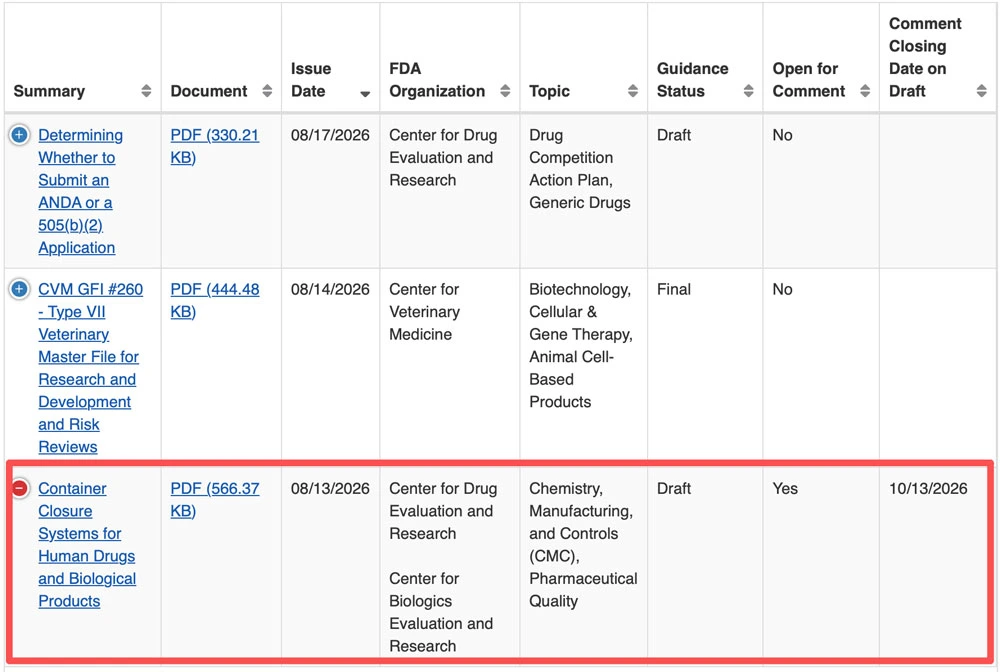
One of the most significant aspects of this update is the elevated status of the container closure system (CCS). A CCS is not merely a protective enclosure for a drug product; it is also a functional component that can affect the product’s therapeutic performance. The guidance expressly requires a comprehensive, risk-based quality assessment of the CCS. This requirement is particularly important for combination products, in which the packaging itself also performs a drug-delivery function, such as with prefilled syringes and autoinjector pens. Because the performance of the packaging can directly affect the safety and effectiveness of the drug product, it must be included in the overall assessment. This change marks a shift in the regulation of drug packaging from protection alone toward systematic management that considers both function and performance
The guidance expressly includes combination products within its scope. In addition, the packaging systems for their device constituent parts must comply with this guidance. This represents a fundamental expansion compared with the previous guidance.
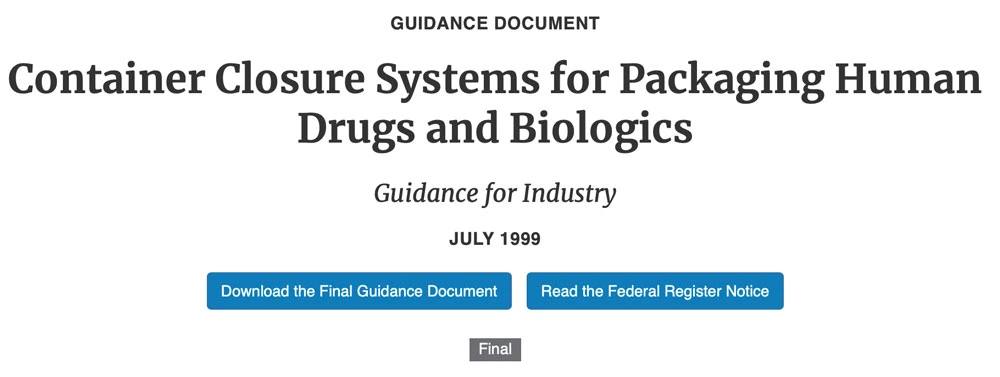
Bilingual Comparison: FDA Draft and Current Guidance on Container Closure Systems (CCS) for Human Drugs and Biological Products
Scope of Comparison and Terminology
This document compares the two FDA guidance documents provided by the user: the May 1999 Container Closure Systems for Packaging Human Drugs and Biologics (the “current guidance”) and the August 2026 draft Container Closure Systems for Human Drugs and Biological Products (the “draft guidance”). Strictly speaking, both are FDA Guidances for Industry, rather than statutes or regulations. Guidance documents generally do not themselves create legally enforceable obligations; however, the statutory, regulatory, and compendial requirements cited in them retain their respective legal effect.
Key conclusion:The draft does not change the fundamental objectives of a CCS—protecting the drug, maintaining compatibility and safety, ensuring functionality, and sustaining quality control. It does, however, transform the 1999 document, which is largely organized around dosage-form categories and tabulated cases, into a risk-based quality framework spanning the full product life cycle. The most material enhancements concern combination products; extractables and leachables (E&L) and toxicological risk; container closure integrity testing (CCIT) for sterile products; shipping and temperature-extreme risks; electronic submissions; and postapproval change management.
Five Changes of Greatest Practical Importance
From “Qualified Packaging Component” to “Controlled Product–Packaging-System Risk”
The current guidance already recognizes that a package suitable for one drug product cannot automatically be assumed suitable for another. The draft develops this principle into an explicit risk-management framework that considers material sources, formulation characteristics, manufacturing treatments, clinical exposure, route of administration, and storage/handling conditions. For example, temporary loss of elastomer elasticity at low temperature, glass delamination caused by sterilization, and increased leachables release caused by organic solvents in the formulation should all be addressed in the risk assessment and control strategy.
E&L Evolves from a High-Risk Product Study Expectation to a Core Life-Cycle Evidence Chain
The principle of conducting extraction studies and toxicological assessments for high-risk settings—such as injectables, inhalation products, ophthalmics, and transdermal products—is not new. The key draft change is that E&L is established as an inherent part of CCS suitability evaluation, explicitly linking commercially representative packaging, shelf-life stability, multiple time points, method validation, threshold setting, and toxicological risk assessment. The draft also notes that ICH Q3E is under development, indicating that E&L expectations are likely to continue moving toward international harmonization and methodological standardization.
Expectations for CCIT in Sterile Products Are Materially Higher
The draft no longer treats container integrity merely as a general protection item. Instead, CCIT becomes core evidence supporting the sterile barrier, closure-process parameters, shelf-life protection, and stability strategy. For freezing, cryogenic conditions, and shipping stress, the draft particularly emphasizes assessment under the worst-case state in which integrity may be transiently compromised, rather than testing only after the sample has returned to ambient conditions.
Combination Products Become a Stand-Alone Regulatory Focus
When the 1999 guidance was issued, the combination-product regulatory framework and device quality system had not yet been integrated in their current form. The draft places CCSs that perform both packaging and delivery functions—such as pumps, MDIs, and prefilled syringes—within the combination-product framework and calls for consideration of design controls, purchasing controls, delivery performance, and, where appropriate, human factors engineering. This is one of the most contemporary structural additions in the draft.
Submission and Postapproval Management Become More Traceable
English. The draft provides eCTD placement mapping and calls for postapproval CCS-change submissions to contain evaluations commensurate with risk; scientific justification should be provided if ordinarily recommended testing is omitted. The current guidance already contains change-reporting principles, but they are comparatively high level. The draft connects these expectations more closely with the ICH Q9/Q10/Q12 concepts of quality risk management, pharmaceutical quality systems, and product life-cycle management.
Concise Considerations for Company Readiness
Applicants seeking to develop products or strengthen supporting data in line with the draft should first establish a “CCS risk dossier.” It should cover all materials and sources, primary/secondary/auxiliary components, component treatments, formulation contact conditions, route of administration, storage and handling conditions, E&L risk, CCIT, functionality/drug-delivery performance, and corresponding control measures. It should also support traceability across development decisions, stability design, submission content, and postapproval change assessments.
A gap assessment should be prioritized for sterile products, cold-chain products, formulations containing organic cosolvents, complex biologics, products administered to locally sensitive tissues, and products with delivery devices. The focus should not be on mechanically increasing the number of tests, but on determining whether testing covers the actual worst-case use scenario and whether analytical, toxicological, device-performance, and transportation evidence jointly support conclusions regarding CCS safety, protection, and functionality.
For supplier and change management, changes to component materials, formulations, processing aids, manufacturing processes, sterilization methods, alternative suppliers, and dimensional tolerances should trigger CCS risk reassessment. Even where a finished component still meets the established specification, the draft indicates that such changes may affect leachables, compatibility, integrity, or delivery performance.
Conclusion
The draft does not overturn the 1999 guidance. Rather, it comprehensively restructures and materially elaborates that guidance in light of contemporary pharmaceutical quality systems, E&L science, sterile-assurance technology, cold-chain logistics, and combination-product regulation. The core principles remain continuous; the principal additional regulatory-preparedness burden lies in risk documentation, E&L toxicological evidence, life-cycle CCIT strategies, cross-disciplinary evidence for combination products, and traceability in eCTD and postapproval change submissions.
References
https://www.fda.gov/media/70788/download (current guidance, May,1999)
https://www.fda.gov/media/194220/download (draft guidance, Aug, 2026)