
Introduction
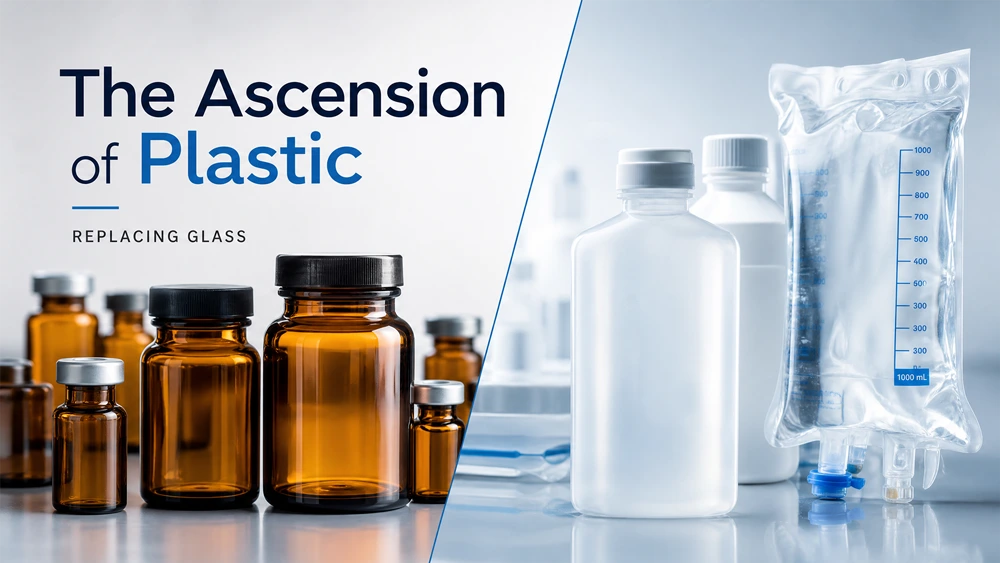
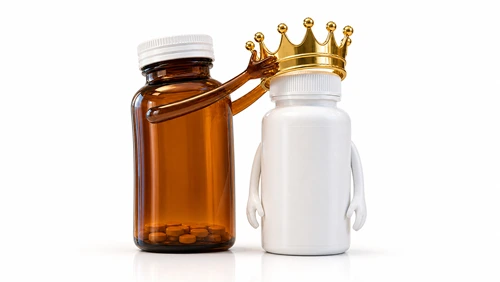
Most people would choose plastic for its lightness, shatter-resistance, and affordability. The same logic applies to pharmaceutical packaging. However, have you ever wondered why plastic, invented just over a century ago, managed to overtake glass, which has been used for thousands of years, and dethrone it from its “kingly position” in medicine bottles? Today, we will delve into the “ascension history” of plastic.
1. How Did Plastic “Infiltrate” Pharmacies?
The birth of plastic was quite accidental. In 1907, a Belgian chemist named Leo Baekeland, while experimenting with phenolic resins in his laboratory, inadvertently created a synthetic material that could be molded – the first true plastic in human history.
However, plastic truly entered the medical field in the 1950s. At that time, hospitals still used glass bottles for intravenous infusions. Nurses had to carry dozens of pounds of heavy glass bottles daily, and a moment of carelessness could lead to breakage, spilling medicine everywhere and potentially causing injuries from glass shards. Pharmaceutical companies and hospitals alike were asking: “Can there be a lighter alternative?”
It was then that a plastic called “polyethylene” emerged. It was lightweight, flexible, shatter-resistant, and low-cost – truly a chosen material sent from heaven to save infusion bottles. Thus, plastic officially “took the stage.” From infusion bottles to medicine bottles, from eye drops to oral solutions, it steadily conquered territory, occupying a large portion of what was once glass bottles’ domain.
2. Plastic’s “Killer Feature”: What Makes It So Powerful?
Plastic’s ability to replace glass relies on several key strengths:
01. Lightweight
A 500mL glass infusion bottle weighs approximately 300 grams, while a plastic bottle of the same size weighs only 20 grams. Being 15 times lighter makes it easier for nurses to carry and patients to handle.
02. Shatter-Resistant
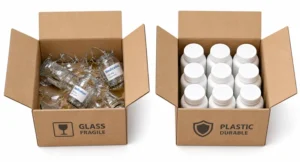
Glass bottles shatter into a mess when dropped, whereas plastic bottles bounce. For hospitals, reducing breakage means reducing costs and risks.
03. Easy to Mold
Glass requires heating to over a thousand degrees Celsius to be molded, while plastic can be injection-molded or blow-molded at one to two hundred degrees Celsius. It can be formed into any desired shape, with bottle bodies that can include handles and child-resistant caps, offering far greater design freedom than glass.
04. Low Cost
Plastic raw materials are inexpensive, and the manufacturing process is simple. With large-scale production, the cost is significantly lower than glass. For pharmaceutical companies, this translates into substantial savings.
05. Selectable Transparency
Glass is either colorless or amber, but plastic can be made completely transparent, translucent, opaque white, or light-blocking. Any desired color and light transmittance can be achieved.
3. Plastic’s “Shortcomings” – Why Didn’t It Completely Eliminate Glass?
Given plastic’s impressive capabilities, why isn’t all medicine packaged in plastic?
Because plastic has its “inherent flaws.”
Shortcoming One: Permeability
Glass is almost impermeable, but plastic is not. Oxygen and water vapor can slowly permeate through it. If a medicine is sensitive to moisture or oxidation, it must be packaged in materials with better barrier properties. This is why some tablets are packaged in aluminum foil blister packs – aluminum foil has much stronger barrier properties than plastic.
Shortcoming Two: Additives May “Leach” into Medicine
Various additives are incorporated during plastic production – antioxidants to prevent aging, plasticizers to make it flexible, and heat stabilizers to prevent degradation at high temperatures. These additives are like “seasonings” for plastic, but if the “seasonings” are incorrect or excessive, they may migrate into the medicine. Therefore, standards like the Chinese Pharmacopoeia have strict regulations regarding this.
Shortcoming Three: Not High-Temperature Resistant
Some injectable preparations require high-temperature sterilization (121°C for 15 minutes), which ordinary plastics cannot withstand, necessitating the use of glass or special plastics. Therefore, it’s not a matter of one replacing the other, but rather each serving its specific purpose – glass for high-temperature sterilization and extremely high barrier requirements, and plastic for lightness, cost-effectiveness, and design flexibility.
4. The “Evolution” of Plastic – From PVC to Non-PVC, a Self-Revolution
Plastic is also “evolving.” Initially, PVC (polyvinyl chloride) was used for infusion bags. However, it posed a hidden danger – large amounts of plasticizers (such as DEHP) were needed to make it soft, and these plasticizers could migrate into the medicinal solution.
Later, scientists developed non-PVC multi-layer co-extruded films – achieving flexibility and barrier properties by stacking multiple materials without plasticizers. This film has a five-layer structure, with each layer serving a specific function: the outer layer prevents oxidation, the middle layer blocks water vapor, and the inner layer maintains stability in contact with the medicinal solution.
Subsequently, cyclic olefin polymers (COC, COP) emerged. With their high transparency, low impurity content, and good heat resistance, they became the “new darlings” for high-end packaging such as pre-filled syringes and cartridge bottles. It can be said that plastic has been constantly undergoing a “self-revolution,” continuously overcoming its shortcomings.